

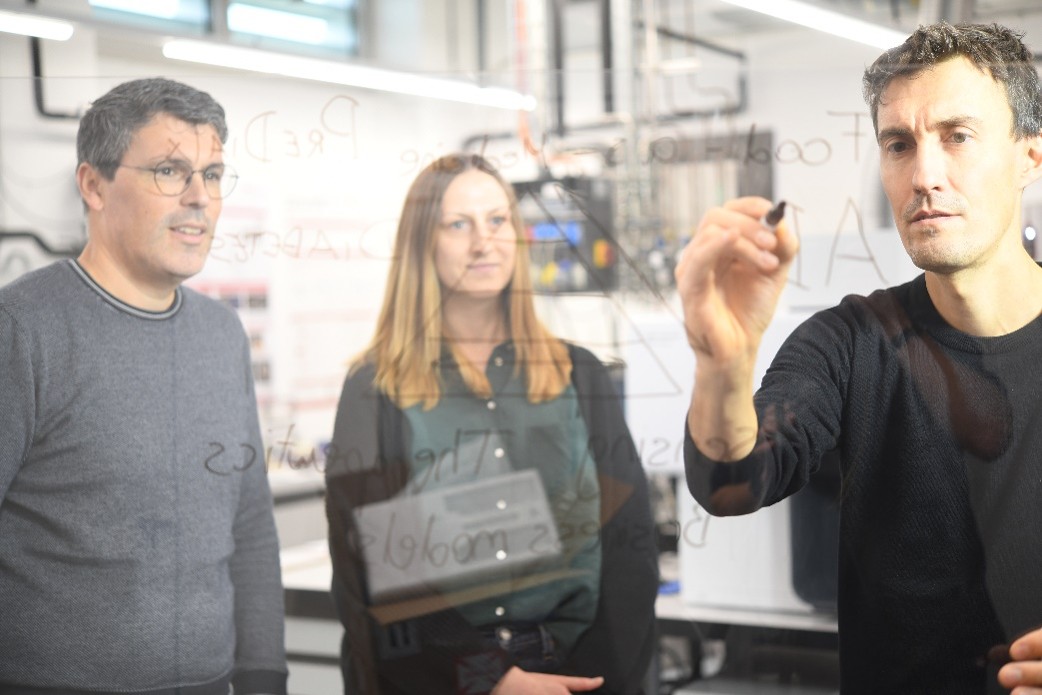
Innosuisse "Flagship" Project to Prevent Type 2 Diabetes Launched.
Type 2 diabetes results in high healthcare costs in Switzerland and causes significant suffering for those affected. A multidisciplinary “flagship” project by Innosuisse, led by Empa, aims to use artificial intelligence (AI), innovative digital sensors, and new business models to facilitate the prevention of this widespread disease.
As an implementation partner, the Switzerland Innovation Park Ost is part of the project consortium. Together with research institutions, companies, and other partners, the park helps bring new technologies into practical use more quickly and advance innovation in the healthcare sector.
Type 2 diabetes is a common disease of affluence. About half a million people in Switzerland are affected by this chronic metabolic disorder—and the number is rising. In type 2 diabetes, the body’s response to the hormone insulin is impaired. Blood sugar levels rise—and with them, the risk of numerous complications, including heart attacks and strokes.
Although genetic factors also play a role, it is primarily our lifestyle that makes this disease a widespread problem. Lack of exercise and an unbalanced diet lead to obesity and, over the years, can also increase the risk of developing “diabetes.” The good news: By changing our lifestyle habits, we could delay or prevent a large proportion of type 2 diabetes cases. The bad news: For most people, making such a change is anything but easy.
So how can we make diabetes prevention more effective and accessible—not only for patients, but also for food companies, health insurance providers, and the healthcare system? This is the focus of the multidisciplinary Innosuisse “Flagship” project “PreDiabeTx,” led by Empa (see box). The project consortium consists of seven research institutions and eleven implementation partners, ranging from health insurance companies and hospitals to public authorities and the food industry. Together, the partners aim to develop and implement digital technologies for the prevention of type 2 diabetes in Switzerland.
A holistic approach
“PreDiabeTx” addresses three major challenges in prevention. The first is the low long-term participation in prevention measures. The project partners emphasize that this is not merely a matter of individual behavior. Systemic factors also play an important role here, such as the structure of incentives, the accessibility of measures for different segments of the population, and funding. The project’s other two focal points are therefore the lack of sustainable business models for prevention among healthcare providers and health insurance companies, as well as the still insufficient use of health data to enable personalized support.
To ensure that innovative approaches do not remain at the research stage, strong ties between academia and industry are essential. This is precisely where the Switzerland Innovation Park Ost comes in: It connects researchers with companies, facilitates collaborations, and supports the testing and further development of new technologies in pilot projects. This creates the conditions necessary to transform scientific findings into marketable solutions.
“Diabetes generates high healthcare costs in Switzerland,” explains Empa researcher Thijs Defraeye, who is leading the project. “By collaborating with partners from various fields, we hope to develop comprehensive prevention measures that will actually be implemented.” Empa researcher Simon Annaheim adds: “Prevention is difficult to measure and quantify. If health insurance companies and businesses cannot quantify how cost-effective these measures are, they find it correspondingly difficult to invest in them.”
That is precisely why one of the five subprojects of “PreDiabeTx,” led by the University of St. Gallen, focuses on sustainable financing and incentive models. “Effective digital diabetes prevention alone is not enough; it must also be integrated into the healthcare system and be mutually beneficial and sustainable for all parties. In our subproject, we are therefore working with CSS, Helsana, Sanitas, and SWICA, as well as cantonal authorities, to develop concrete business and incentive models that can establish digital therapies as an integral part of standard care,” says Elgar Fleisch, professor at the University of St. Gallen and head of the subproject.
Eating Healthier Thanks to AI
Two other subprojects focus on digital tools for diabetes prevention that can use AI to provide personalized advice for a healthier lifestyle. “We want to develop a ‘digital coach’ that supports people while they’re shopping and cooking,” says Empa researcher and project leader Cynthia Sob. According to the researcher, diet can have a significant impact on one’s health.
This so-called “Food as Medicine” approach is gaining increasing importance in medical research—but is not yet widespread in Switzerland. “In the U.S., there are already health insurance companies that issue prescriptions for healthy foods, thereby promoting healthy eating. We want to investigate to what extent comparable approaches would also be possible within the Swiss insurance system,” explains Defraeye. This would make vegetables a bit more financially appealing than a chocolate croissant.
This also benefits people with lower socioeconomic status—who are already at higher risk of developing type 2 diabetes. A separate subproject of “PreDiabeTx” is dedicated to them and other at-risk population groups. As part of this subproject, the partners are developing digital coaches tailored to these groups, which take their specific needs into account and provide personalized, easy-to-follow advice.
Sensor T-Shirt for Monitoring Progress
The last two subprojects rely on non-invasive measurements suitable for everyday use to demonstrate the success of the preventive measures. One of these, led by the University of St. Gallen, focuses on wearables—devices such as smartwatches that continuously monitor vital signs. The second, led by Simon Annaheim at Empa, relies on textile sensors. “We’re convinced that occasional measurements at the doctor’s office or pharmacy don’t provide an accurate enough picture of a person’s health,” says Annaheim. The researcher and his team have therefore specialized in developing soft textile sensors that can be integrated into items such as a chest strap or a T-shirt, allowing vital signs to be recorded comfortably and discreetly even during everyday activities. Unlike wrist-based measurements, such as those taken by most smartwatches, the textile sensors worn on the torso are somewhat more complex. However, they provide more accurate readings. According to Annaheim, they could thus be used to monitor health status over several days.
What all the measurements in the project have in common is that they are non-invasive—that is, they do not penetrate the skin. Blood glucose levels cannot yet be reliably measured this way. However, the other measured values—such as heart rate, respiratory rate, blood pressure, and oxygen saturation—do allow for conclusions to be drawn about a person’s state of health. The researchers aim to use AI-powered algorithms to better understand how the measured vital signs are related to diabetes risk.
Help Instead of Lecturing
This is what smart and sustainable Type 2 diabetes prevention could look like in the future: An AI coach provides personalized dietary advice tailored precisely to each user’s specific situation, making it easier to follow. Targeted incentive programs and initiatives from health insurance companies and other organizations further facilitate a healthy lifestyle. And doctors, as well as patients themselves, monitor progress using wearable sensors.
“We don’t want to make anyone feel guilty or scared; rather, we want to offer support and make a healthy lifestyle more accessible,” says Simon Annaheim. The benefits are far-reaching: “By preventing type 2 diabetes, you also prevent other health problems, such as certain types of cancer,” says Cynthia Sob. “But unlike cancer risk, the reduction in diabetes risk can be measured much more effectively in a short period of time.” The researchers are convinced that when patients quickly see and feel their health improving, it gives them additional motivation.
There is still a lot of work to be done before this vision for the future is realized. “PreDiabeTx” launched at the end of 2025 and will run through the end of 2029. “Of course, we won’t solve a problem that has developed over decades in just four years,” says Annaheim. “But we hope that, through our complementary and holistic approach—together with our implementation partners—we can take diabetes prevention a step further.”
PreDiabeTx is part of the activities of the Health Innovation Hub at Switzerland Innovation Park Ost and demonstrates how joint innovation projects can accelerate the transfer of new technologies into practice. This benefits startups, SMEs, and industry partners as well as the healthcare sector.
“PreDiabeTx”
“PreDiabeTx” is a “flagship” initiative of Innosuisse, the Swiss Agency for Innovation Promotion. The transdisciplinary project aims to strengthen the prevention of type 2 diabetes in Switzerland through data-driven digital tools and sustainable business models. “PreDiabeTx” launched at the end of 2025 and will run through the end of 2029. The consortium is coordinated by Empa and also includes the research institutions University of St. Gallen, ETH Zurich, University of Zurich, University of Applied Sciences and Arts of Eastern Switzerland, Bern University of Applied Sciences, and Inselspital Bern. Implementation partners include ACCYOURATE, Lealy, Pathmate Technologies, RE-NUT, Switzerland Innovation Park Ost, the health insurers CSS, Helsana, Sanitas, and SWICA, the HOCH Health Ostschweiz hospital network, and the Canton of St. Gallen.
Are you developing innovative solutions in the fields of digital health, prevention, or medtech? Then let’s talk. Together, we’ll lay the groundwork to turn innovations into real-world applications.
Contact for collaboration inquiries:
Jean-Philippe Doyen
jean-philippe.doyen@innovationspark-ost.ch